

Who's Feeling Lucky?
Notes on the jackpotopalypse

Over the holidays I finally got around to the 2018 Oscar-winning documentary Free Solo, which follows rock climber Alex Honnold in his successful attempt to “free solo”—climb without ropes—the planetary-scale imposition that is Yosemite’s El Capitan. As someone whose attitude toward extreme sport is “…why?”, I was moved by the film’s thoughtful character study of not just the freak (complimentary) at its center, but of all the people around Honnold who wrestle with what it means to support and ethically document a man possessed by a life-risking ambition.
And then, a few weeks later, I saw this X post:
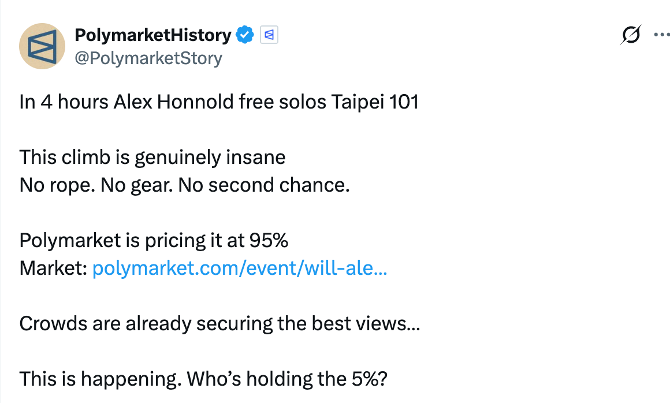
Fear not, anyone who didn’t hear about this: he climbed the skyscraper. Netflix enjoyed decent ratings on its latest play in live events (while paying the star “embarrassingly” little). Meanwhile, Polymarket hosted $2 million in bets on whether a man would live or die in streaming hi-def.1
The contrast between Free Solo and Skyscraper Live—as gladiatorial spectacle, but especially as grist for prediction markets—speaks to a national mood I’ve otherwise been thinking of as big late-night casino energy. Craven leadership and disenfranchised normal folk alike are chasing jackpots and looking to cash out before the last parties end, while all of us endure complicity with profit motives that are, more and more openly, commercializing human life along with everything else. Questions about the kind of future we want to build, and who we want to survive to see it, seem displaced in a creeping swath of public discourse by a binary prompt: do you want in on those odds?
“Which countries will Iran strike in March?” “What was Ilhan Omar sprayed with?” “Measles cases in U.S. in 2026?” “Where will 2026 rank among the hottest years on record?” “Jeffrey Epstein confirmed to be alive before 2027?” “US civil war before 2027?” “Will Jesus Christ return before 2027?”
You may have heard about the new vogue for prediction markets, or what the rest of us might call gambling on literally everything. Where? Maybe when CNN inked a deal with Kalshi (tagline: Prediction Market for Trading the Future) to integrate event prediction odds across its broadcasts. Maybe it was when the Golden Globes decided viewers wanted a live ticker of Polymarket odds laid over the footage of all the celebrities on whose chances you could be spending your crypto. Maybe you’ve seen one of Kalshi’s noxious AI-generated ads, such as the NBA Finals spot with the slogan, “The world’s gone mad, trade it.” Maybe it was when someone made over $400,000 off of Maduro’s capture, spurring a Democratic bill to outlaw government insider trading. Or when someone else made over $550,000 on Ayatollah Ali Khamenei’s death this past weekend. Or when the Associated Press announced yesterday that it will be sharing its gold-standard election data with Kalshi. Maybe (unlikely) you’re eagerly awaiting Truth Predict, Trump’s play to get in on a wave that saw nearly $12 billion dollars traded on the two biggest players, the aforementioned Kalshi and Polymarket, last December—a 400 percent increase over the previous year.
It’s a fast-catching fever, yet it’s also been rising for a while. There was the seismic market expansion in 2018 when the Supreme Court de facto legalized sports betting—when it became something anyone could do from his (usually “his”) phone, advertised constantly during games, making a mint for the people holding the odds while catalyzing an addiction epidemic. The rise of crypto and meme stocks, with correspondingly democratized investment platforms, have brought new communities into the ur-gambler’s den (the stock market), where the Trump administration’s de-regulation fetishists are working to loosen more restraints.
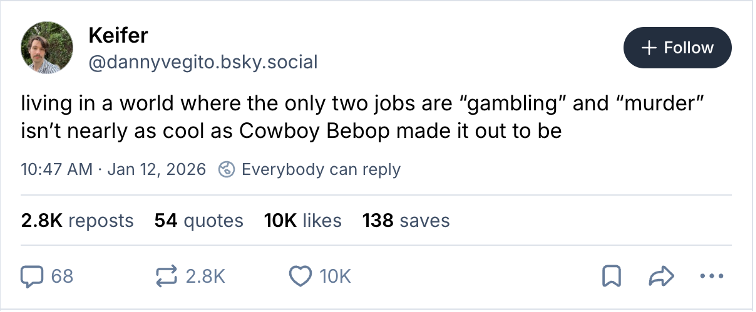
Still, last year felt like a new phase in whatever’s going on. Nate Silver, once the left’s favorite stat nerd, showed his opportunistic true colors with a book called The River: an extended fan-boy letter to those schooled in “the art of risking everything,” which to him includes “crypto kings,” “venture capital billionaires,” and decidedly not lame, risk-averse “institutions like academia and the media.” The co-founder of Kalshi said to a rapt room of finance elites, “The long-term vision is to financialize everything and create a tradable asset out of any difference in opinion,” like someone not describing a dystopia. Trump staged his last big speech on affordability at a casino.
Why now? Why is the prediction market craze hitting so hard, where it is? Why is CNN so eager to filter geopolitics through bettors’ odds? Why is gambling (or trading, or predicting for profit, mutatis mutandis) an increasingly inescapable frame in the way we talk about the near future?
The shortest answer is “the 2024 election,” which saw over 3.6 billion dollars bet on the outcome on Polymarket alone—far more than any previous election—and which predicted Trump’s win better than many polls, juicing interest in prediction markets. But the fact that more people opted to short democracy than not (roughly $1.5 billion of Polymarketers’ crypto was bet on Trump, vs. $1 billion on Harris) is an outbreak, not the disease.
I’m interested in the vibes-level crisis beneath: i.e., big late night casino energy. It feels like the end of the world, under which assumption one move is to try to cash out while the cash is good. For the wealthy and empowered this looks like a new kleptocracy, stripping the federal government for parts; to the extent anything about American democracy is coming to an end, it’s their fault. For a certain kind of everyman (usually -man), it looks like the rest of the above rackets, from meme stocks to betting on war. Climate anxiety (sometimes in the grief stage of climate denialism), AI hyperventilation, and crypto-evangelism permeate both sides. Everyone’s Roman Empire is the late Roman Empire. This casino has only zero-sum games — but hey, you might be one of the lucky ones to hit the jackpot and line your go-bag with the winnings.
“Favorable chance…is the god of all men who follow their own devices instead of obeying a law they believe in,” George Eliot once wrote. Those currently at the top never believed laws should apply to them in the first place, and it seems they’d rather roll the dice on burning it all down than deign to work within a democracy. Those currently being victimized by their supreme arrogance and greed—the rest of us—can be forgiven for losing a little faith in the world outside our own devices.
A few problems.
For one, we’re the suckers. A jackpot/end-times approach to profits only works for the people who were already going to do well: the ones benefiting from the spoils system, the ones replacing their workers with robots, the ones playing the house for all the bets made by people with less to wager and more to lose. It’s a whale fall and we’re the whales.
Two: the more prediction markets permeate our media, the more we risk their narratives warping reality—something that should worry all of us in the lead-up to this year’s midterms. Saahil Desai laid out a hypothetical in The Atlantic: “A billionaire congressional candidate can’t just send a check to Quinnipiac University and suddenly find himself as the polling front-runner, but he can place enormous Polymarket bets on himself that move the odds in his favor.” If CNN keeps breathlessly foregrounding these monetized metrics of public sentiment, and the AP is all about “meeting audiences where they are” (as a representative rationalized their deal with Kalshi), suddenly we have yet another pipeline for money to influence elections and another attack surface to undermine data neutrality and integrity. Or rather—we have an “important check on our news media and our information streams,” as per Trump’s CFDC chairman/toady, who says that no one should regulate these markets except him.
Three: most intangibly, the “financialize everything” mindset is anathema to the kind of personal investment it takes to, well, care. When you bet on an event, there’s a necessary removal of self from the proceedings, and a moral flattening of the outcomes: your job is to watch and, good or bad, if what you thought would happen happens, you win. Over half a billion dollars were already traded on the Iran conflict as Tehran burned under the first wave of U.S.-Israeli bombs.
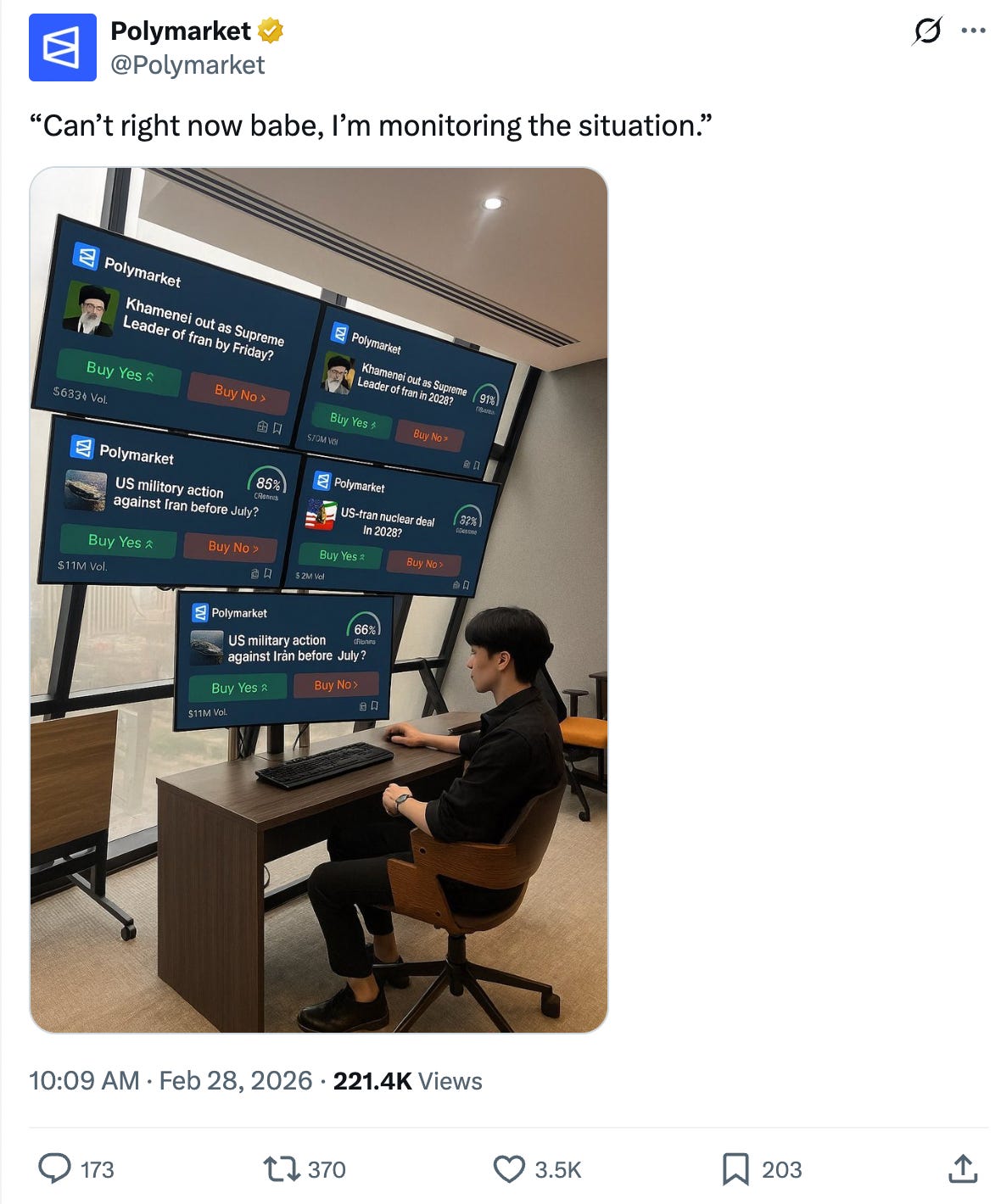
Betting on a new forever war or the continued rise of fascism isn’t canny pessimism (or, to quote, the newest gamifying meme, “monitoring the situation”). It’s cynicism, fatalism, nihilism. If you’re betting that someone will die, guess what you’re not doing: helping them live.
I’m sympathetic to anyone who feels powerless to act on so much of what’s going on these days — I do, often. And I’ve played the lotto; I know the thrill in feeling like you could be the exception to bad odds. We should all get to get one over on the house, for once. I’m not here to stop anyone’s date with luck.
But with the big uncertainties, where what’s at stake is the kind of nation and world we want to live in, I’m hoping the tide turns away from this trend. There are still laws worth believing in, and communities worth building, and outcomes worth rooting for not because we think they’re the most objectively likely, in a moral vacuum, but because they’re the future we want to see. Luck is not how we get out of this.
Someone please tell CNN.2 And someone else tell Alex Honnold he should charge Netflix more next time.
Along with over $5 million in bets on how long the climb would take him. Yes, Netflix had a 10-second delay built into the livestream. And yes, the people betting “against” Honnold’s success would profit not only if he died but also if he chose to postpone the climb or abort partway through. But when the platform you’re betting on is ginning up excitement with promos like, “No second chance….Who’s holding the 5%?,” call it what it is, cowards.
Ideally before their potential Paramount lobotomy.
I have my vices, but gambling never was one of them. It's beyond me how people smarter than Donald Trump, who somehow lost his casinos even though the house always wins, don't understand the odds of not getting rich by frittering their cash away. Please, America! Take a turn toward reality. Preserve the fun in sports and the fun in not knowing what's around the corner by rejecting speculation.
There is no question that any betting that would encourage perverse incentives should be plainly illegal including elections and <sighs deeply> military and police action. It feels like governments around the world are laser focused on ending online privacy to "protect the children" while turning a blind eye toward a broken system where profiting off of misery and corruption is not only acceptable but easily accessible to the masses.