


I heard Jane Goodall lecture over 50 years ago. After that experience, and later watching the documentary about her early years studying chimps in the wild and reading her first book, In the Shadow of Man, I became a heartfelt devotee of Goodall, the renowned primatologist, scientist, and conservationist who passed away last week at the age of ninety-one. She was a trailblazing scientist, a glass-ceiling breaker, an elegant speaker, and a dedicated activist who possessed a level of humility and dignity one rarely sees in public figures who receive worldwide acclaim. That alone made her compelling. Personally, my love of animals and travel spurred my fascination with her career.
However, it was not until I saw her posthumously-released interview that I fully appreciated that it was her abiding faith in the sanctity of individuals and the power of our collective agency that set such a powerful example for me.
Her interview should absolutely be watched in its entirety. But one portion transcended her field and seemed particularly attuned to our current crises:
I want to make sure that you all understand that each and every one of you has a role to play. You may not know it, you may not find it, but your life matters, and you are here for a reason.
And I just hope that reason will become apparent as you live through your life. I want you to know that, whether or not you find that role that you’re supposed to play, your life does matter, and that every single day you live, you make a difference in the world. And you get to choose the difference that you make.
I want you to understand that we are part of the natural world. And even today, when the planet is dark, there still is hope. Don’t lose hope. If you lose hope, you become apathetic and do nothing. And if you want to save what is still beautiful in this world—if you want to save the planet for the future generations, your grandchildren, their grandchildren—then think about the actions you take each day.
Because, multiplied a million, a billion times, even small actions will make for great change.
She may have been focused primarily on climate change and conservation, but her guiding philosophy delivered with such sincerity also serves us well as we battle not just for the survival of the planet, but the survival of our democracy. Her faith that we all have a role, a purpose (what Nancy Pelosi calls our “why”) speaks to people who may currently feel powerless. Her insight that finding one’s purpose is a lifelong process recognizes that we can find our path at age nine or age ninety. And her clarion call to use our agency to save “what is beautiful” applies to the ongoing struggle to save what is just and decent and true.
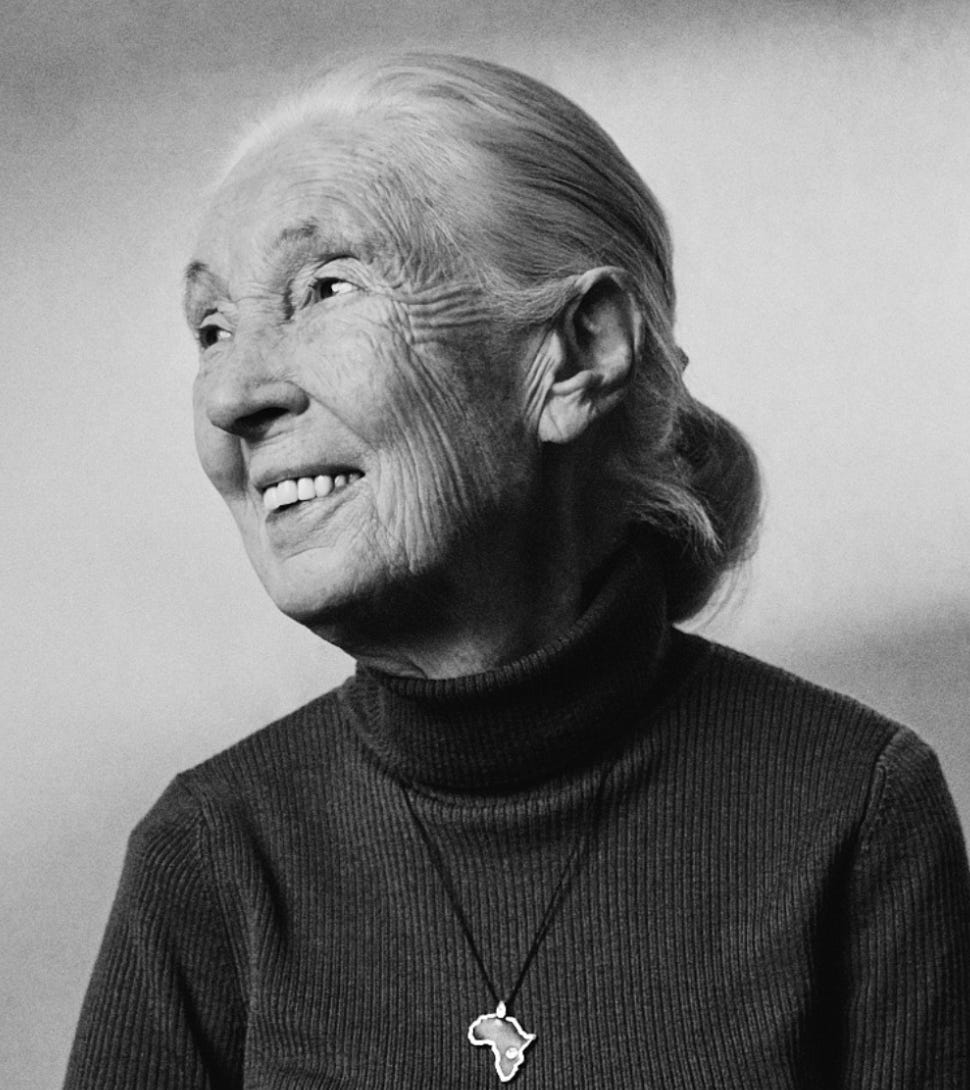
Goodall’s message translated into the world of politics and governance is powerful and universal. It is not hard to figure out why despotic, cruel, hateful, anti-intellectual, and corrupt forces spend so much effort trying to intimidate and cow us into submission, silence our voices, and prod us to collapse in a puddle of fatalism.
Donald Trump’s over-the-top invective, deployment of violent shock troops, nonstop lies and chaos, and utter domination of his own party are all designed to paralyze or at least disorient pro-democracy forces. It would be so easy to conclude that the MAGA storm is so destructive and all-encompassing that resistance is futile.
But, as Goodall warns us, “If you lose hope, you become apathetic and do nothing.” Her admonition to preserve hope applies directly to the fight for democracy, truth, fairness, decency, and human progress. Without hope, we do not vote, protest, speak out, or resist. In other words, democracy dies in paralysis and despair.
Her remarks also remind us that very few people attain the reach and influence of a Jane Goodall (or a Ghandi, a Martin Luther King, Jr., or a Ruth Bader Ginsburg) but that our failure to achieve universal recognition should not be the measure of our success or effectiveness. Indeed, those heroic figures succeeded to the degree they did by influencing the rest of us. They became who they were because millions, if not billions, echoed their words, magnified their actions, and built on their insights.
In the political realm, an undaunted figure such as Goodall provides a much needed infusion of energy and optimism. But there are innumerable others who provide inspiration every week, all with different purposes, and all of whom we need to carry on the fight—from the Portland Frog demonstrator whose gentle humor perfectly embodies the essence of its city to WNBA star Napheesa Collier who took on the clueless and condescending league commissioner to ACLU lawyers filing dozens of cases around the country to ordinary Americans documenting government misconduct and photographing ICE abuse to activists from Indivisible and other groups organizing the second No Kings Day to teachers devoted to protecting and enlightening their students. Each plays a critical role in preserving our democracy. And so do you.
Goodall’s impactful life should inspire and energize us in the fight for democracy—but as do so many others who are finding their role. We will need every one of them to defeat a movement built on lies, intimidation, abuse of power, cynicism, greed, ignorance, and hate. We salute the undaunted, the unbowed, and the unafraid—however large or small their profile.
Congratulations to Maria Corina Machado for being awarded the Nobel Peace Prize for standing up to a dictator. The Nobel Committee's remarks in describing why she was chosen explain eloquently why a certain American president wasn't considered worthy of this prize. He'll never understand why character matters--or even what it is.
Thank you! What a beautiful way to start the day!!