

Last week’s Munich Security Conference Confirmed Uncertainty, Not Unity
For the second year in a row, Europe voiced concern, Washington offered reassurance, and nothing truly changed.

The Winter Olympics, currently underway in Italy, bring anticipation and a sense of shared purpose. The annual Munich Security Conference is more bureaucratic than celebratory, but it usually carries its own undercurrent of anticipation and teamwork.
The Munich gathering is where the transatlantic alliance takes its own measure. Leaders arrive, reaffirm a shared purpose, and leave with the comforting sense that the security framework still works.
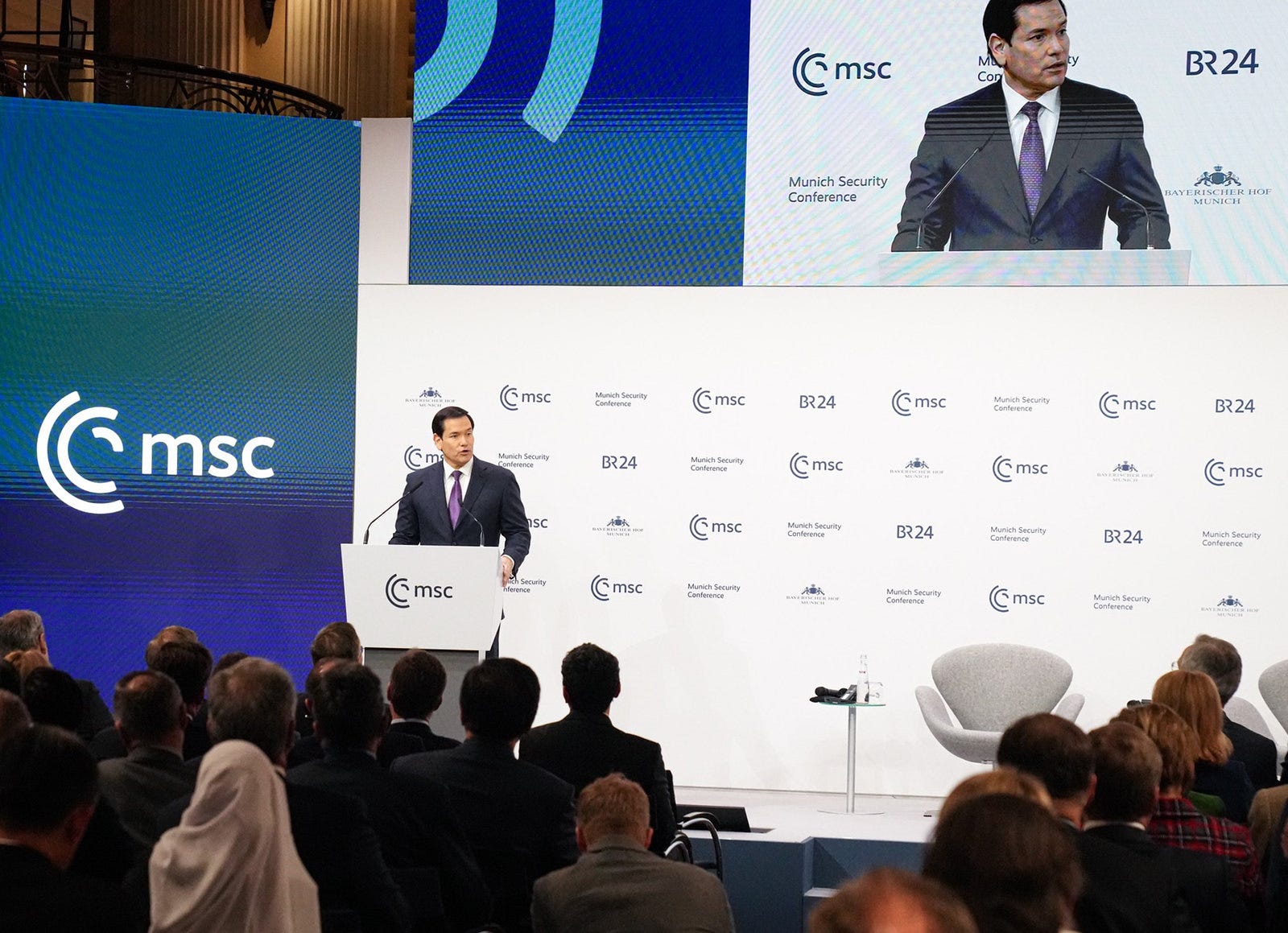
Few participants at the weekend’s conference would depart with much confidence. Donald Trump’s recent confrontation with NATO members over Greenland and his long-running habit of talking about the Atlantic alliance as if it were an invoice rather than an institution made it hard to imagine Munich producing anything more than stagecraft.
On Ukraine, especially, the “deliverable” was likely to be familiar: solemn language, thin specificity, and carefully worded ambiguity that preserves room for Washington to change its mind.
Even the conference’s own framing hinted at a gathering designed to manage damage rather than settle strategy. The Munich Security Report’s headline diagnosis — an era of “wrecking-ball politics,” with the United States alternating between reassurance, conditionality, and coercion — did not suggest a meeting where budgets, procurement, and operational plans would snap into tighter alignment.
German Chancellor Friedrich Merz, among the first major speakers, did not indulge the usual Munich pieties. His remarks read less like a diplomatic welcome and more like an intervention. He warned that Europe’s “freedom is no longer simply guaranteed,” Washington has “squandered” its claim to leadership, and the “international order based on rights and rules … no longer exists in the way it once did.” He emphasized that disregarding the alliance will come at a grave cost to the United States, which will not be powerful enough to go it alone — reframing NATO not as Europe’s shelter but as an American strategic advantage. And he treated the transatlantic rift as structural, not atmospheric: The culture-war politics and protectionist instincts now emanating from Washington are not a misunderstanding to be smoothed over but a divergence Europe has to plan around.
Despite this tense opening, many observers remained confident the conference would not devolve into a sequel to last year’s spectacle — an American delegation led by Vice President JD Vance berating Europeans about their political choices. Secretary of State Marco Rubio, as this year’s senior U.S. representative, was widely assumed to be a steadier messenger — someone who could lower the temperature while keeping the relationship functional.
What followed showed why tone and method can point in different directions. Before Rubio offered any public reassurance, he sent the first signal that mattered more than any stage-managed line: a last-minute decision to skip the “Berlin Format” meeting on Ukraine, which was attended by NATO and European leaders, including Ukrainian President Volodymyr Zelenskyy. This was not a minor calendar mishap. It was a procedural message about hierarchy. NATO Secretary-General Mark Rutte fell back on a familiar move of explaining it away, describing Rubio’s absence as a scheduling conflict rather than a choice. But this was not a minor calendar mishap. It was a procedural message about hierarchy.
When it came time for Rubio to speak, he paired warm reassurance with familiar grievance — calling the U.S.–Europe bond “unbreakable,” then pivoting to complaints about European energy policy, migration, and what he cast as “civilizational erasure.” Many outlets treated Rubio’s subsequent speech as proof the alliance remains “bruised but still friendly,” with The Financial Times describing the mood in the room as one of relief.
Unlike Vance’s jolt the year before, Rubio spoke in the language of reassurance — but the themes were familiar and the criticisms unchanged.
Attendees were eager to pretend the bargain had been restored. European Commission president Ursula von der Leyen’s response — delivered straight after Rubio — was notably tenser and more honest about the damage, but it still carried Europe’s familiar restraint. Other European leaders echoed these points.
I understand why the room exhaled. Everyone likes a speech that sounds like the old days — history, kinship, and an “unbreakable link.” But a familiar accent is not a strategy. “Bruised but still friendly” is comfort dressed up as analysis — and comfort is how you end up back on the field with Lucy and the football.
Rubio’s job at Munich was not to change the operating model; it was to make that model easier to tolerate for another news cycle. But the hinge is not Rubio. The hinge is Trump. One speech cannot stabilize a relationship whose core commitment is still conditional, where the White House treats the alliance as leverage. If anything, the sequence of the weekend said the quiet part out loud: Europe can be essential to implementation and still optional to the decisions that shape outcomes.
Merz was right to call this a security crisis for both sides. He named the rupture, warned that the old order is gone, and still spoke in the language of repair. That was the pattern all weekend: leaders acknowledging that the relationship is damaged while speaking as if it can be restored through effort and goodwill.
But Munich offered no evidence of repair, only relief at a calmer tone and enduring uncertainty about commitments and operational alignment. The operating model did not change. The United States still signaled that commitment is conditional, and Europe still responded as if reassurance might return.
And for the United States? In a world of peer rivalry, weaponized interdependence, and wars that reward endurance, a United States that alienates its closest partners is not asserting strength. It is dismantling its own margin for error — and teaching adversaries to plan for an America whose commitments are unpredictable, possibly unreliable, in critical moments.
Brian O’Neill, a retired senior executive from the CIA and National Counterterrorism Center, is an instructor on strategic intelligence at Georgia Tech. His Safehouse Briefing Substack looks at what’s ahead in global security, geopolitics, and national strategy.
 | A guest post by
|
Thank you. Your analysis is critically important to helping us understand these new and shifting transatlantic and international alliances. Sadly, the analysis doesn't bring comfort.
I was glad AOC went and reminded, ALL americans are not idiots.