

Jackie Robinson Found Acceptance in Montreal
Eighty years ago, the man who broke baseball's color barrier suffered abuse in U.S. cities.
By Frederic J. Frommer
Eighty years ago, on the eve of breaking Major League Baseball’s modern-day color barrier, Jackie Robinson spent a year with the Brooklyn Dodgers’ top minor league team in Montreal. That 1946 season playing for the Montreal Royals would offer a preview of the abuse he’d face in the major leagues starting in 1947 – as well as a comforting welcome north of the border.
Robinson began the ’46 season at the Dodgers spring training site in Sanford, Fla., where he was excluded from the team hotel and lodged at a private residence instead.
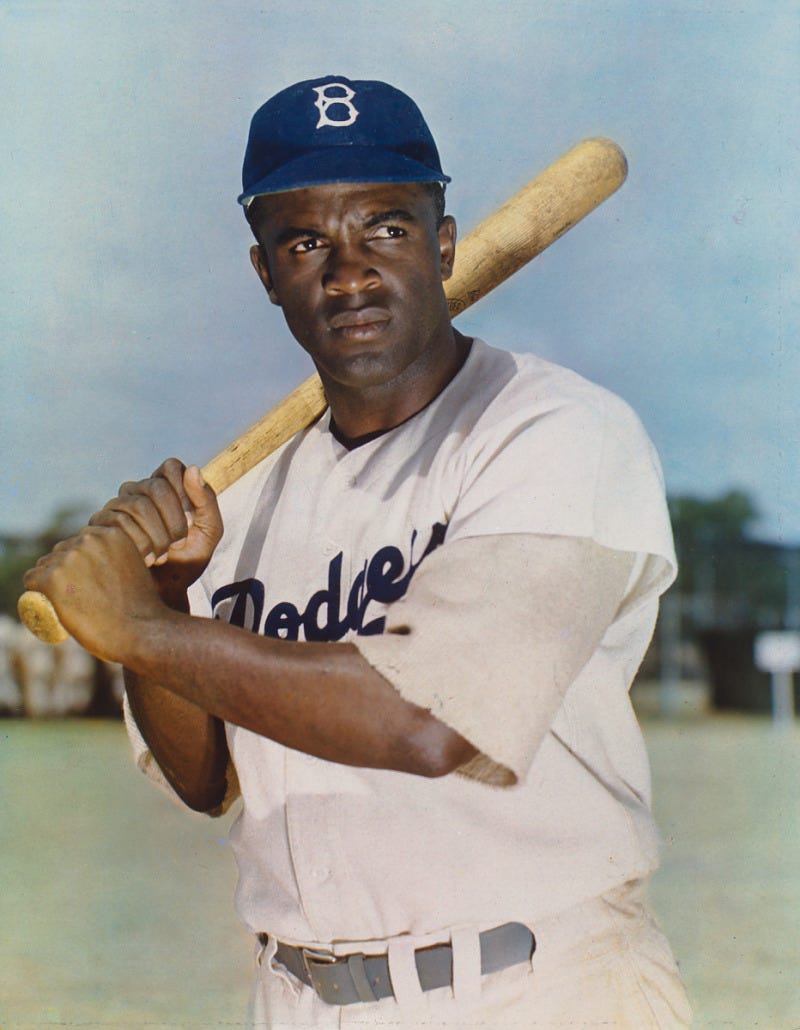
The Royals played in the International League, which consisted mostly of northern teams. But there were concerns that even those cities would rebel at the thought of a Black man playing at their minor league park. On the eve of the team’s Opening Day game in Jersey City, league president Frank Shaughnessy warned Dodgers president Branch Rickey that if Robinson came, “you’re going to have a race riot.” Robinson played, and there were no riots.
The most southern city in the league was in Baltimore, where fans threatened a boycott if Robinson took the field. He played under a constant barrage of abuse. His wife, Rachel, was an unfortunate eyewitness to it from the stands.
“Soon insults were coming from all over the stands,” Robinson wrote in his autobiography, I Never Had it Made. “For me on the field it was not as bad as it was for Rae, forced to sit in the midst of the hostile spectators. It was almost impossible for her to keep her temper, but her dignity was more important to her than descending to the level of those ignorant bigots.”
Things took an immediate turn when the team, and Robinson’s young family, traveled home to Canada. A sportswriter later described it this way: “For Jackie Robinson and the city of Montreal, it was love at first sight.”
“He was right,” Robinson agreed.
As he wrote:
After the rejections, unpleasantness, and uncertainties, it was encouraging to find an atmosphere of complete acceptance and something approaching adulation. The people of Montreal were warm and wonderful to us. We rented a pretty apartment in the French-Canadian sector. Our neighbors and everyone we encountered were so attentive and kind to us that we had very little privacy. We were stared at on the street, but the stares were friendly. Kids trailed along behind us, an adoring retinue.
Back on the road, things returned to form — even in a northern city like Syracuse, N.Y. But rather than the fans, the abuse that day came mostly from the opponents, who taunted Robinson for his race the entire game. Mixing animal cruelty with a racist insult, one player threw a live black cat on the field, and yelled, “Hey, Jackie, there’s your cousin.”
Robinson recalled that he doubled and scored after the incident. As he passed the home team dugout, he shouted, “I guess my cousin’s pretty happy now.”
Robinson won the batting title that year with a .349 average. At the end of the season, when the team returned to Baltimore, “there were no more taunts and epithets,” he recalled. “Instead, I got a big standing ovation after I stole home in one of the games.”
The Royals won the pennant, setting up the “Junior World Series” against the winner of the American Association, the Louisville Colonels. The first three games were in Louisville.
“In a quiet but firm way Louisville was as rigidly segregationist as any city in the Deep South,” Robinson recalled in his memoir. “The tension was terrible, and I was greeted with some of the worst vituperation I had yet experienced.”
And Robinson delighted the bigoted fans with a mini-slump that saw him go 1-for-11 in the three games.
“The worse I played, the more vicious that howling mob in the stands became,” he wrote. “I had been booed pretty soundly before, but nothing like this. A torrent of mass hatred burst from the stands with virtually every move I made.”
The Colonels took two of the three games in Louisville, then the series shifted to Montreal, where the Royals would need to win three of four to win the championship. Montrealers were furious at how their star had been treated.
“Greeting us warmly, they let us know how they felt,” Robinson wrote. “They displayed their resentment against Louisville and their loyalty to us on the first day of our return to play the final games by letting loose an avalanche of boos against the Louisville players the minute they came on the field.”
“It was difficult to be sure how I felt,” he reflected. “I didn’t approve of this kind of retaliation, but I felt a jubilant sense of gratitude for the way the Canadians expressed their feelings. When fans go to bat for you like that, you feel it would be easy to play for them forever.”
Robinson’s slump evaporated, helping the team reel off three straight victories to win the series. He wound up hitting .333 for the series. As the game ended, there was bedlam. As he recalled:
I rushed through the happy Montreal crowds swarming over the field, got into the clubhouse, but before I could shower and dress, an usher came in to tell me the fans were still waiting to tell me good-bye. He neglected to mention that there were thousands of them. They grabbed me, they slapped my back. They hugged me. Women kissed me. Kids grinned and crowded around me. Men took me … on their shoulders and went around the field, singing and shouting. I finally broke away, showered and dressed, and came out to find thousands still waiting.
In the Pittsburgh Courier, a Black newspaper, Sam Maltin famously wrote, “It was probably the only day in history that a Black man ran from a white mob with love instead of lynching on its mind.”
Frederic J. Frommer, a writer and sports and politics historian, has written for the Washington Post, the New York Times, the Atlantic, History.com and other national publications. He will be delivering a Smithsonian Associates talk on Jackie Robinson’s legacy, along with Phil Hochberg, on Feb. 19 via Zoom.
I welcome these stories to show that sports can make us more accepting. When I watch baseball these days, I see a wonderful blend of races, body types, work ethics, and styles. It's why I love baseball more than the other pro sports that require too many of the same physical and mental types to suit the range of play. In baseball, the variations in position, the different ways a ball can react off a bat and different ways it can be fielded, and even the weather create room for all kinds of diversity among players.
If only Jackie Robinson were just starting out. But he started something that is slowly paying off.
Awesome article! Thank you.